
People who haven't lived with rabbits often ask me if rabbits make "good pets". I almost never have the time to properly explain why this question shouldn't really apply to rabbits, nor why I think rabbits are NOT for most people. Hence, since I have found time, I shall do just that.


 No small part of the problem lies in our use of the term "pet." After all, a pet is "one who is petted," implying passivity and ownership. We seldom call other human beings "pets," and most people would consider it an insult if we did. By using the term to describe animals we are diminishing their importance in our lives. We are denying their right to individuality and a lifestyle that may or may not include allowing us to fawn over them. On the other hand, a rabbit who is a companion is one who’s like our human friends, and is encouraged to develop the personality nature gave her and is appreciated for who she is.
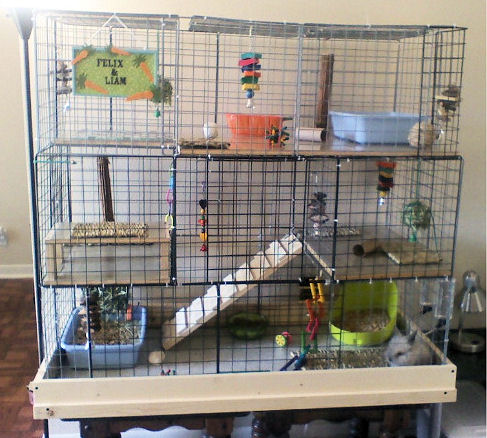
 Most rabbit cages sold in pet stores are too small. Your bunny needs more than just a few square feet for her home. If your rabbit is free to roam through the whole house or an entire room, a small cage like this may be ok as a base of operations. But if your rabbit is in her cage for extended periods of time, she'll need a much larger place to live. A rabbit's cage should be a minimum of five times the size of the rabbit. She should be able to completely stretch out in her cage and stand up on her hind legs without bumping her head on the top of the cage. Look for larger, multi-level rabbit homes offered by some pet supply stores and specialty online retailers. These cages give your bunny a lot of room to move around. Whatever type of cage you get, make sure that the floors and resting platforms are solid, not wire, which can hurt your rabbits feet.

 Parents should always be the primary care taker of any animal family member. Small children and rabbits do not make a good combination. Young children do not have the dexterity to handle a rabbit safely and securely. Often, when small children attempt to lift and/or carry a rabbit, one or both end up hurt. I do not recommend children under the age of nine to be allowed to handle rabbits. All too often, parents purchase a rabbit for a child family member; Easter is one of the heaviest times of the year for this. The child is excited, the rabbit is terrified, the child looses interest, the rabbit is ignored and unwanted and the parents end up disappointed and resentful. It is the parent's responsibility, regardless of the situation, to ensure that ALL family members are safe, happy, healthy, cared for and loved.
 Any introductions should be done slowly and with strict supervision. Some animals should not ever be considered for introductions. One such animal is a ferret. They are precise, accurate, and avid hunters of rabbits. Dogs should never be left alone with a rabbit. The most friendly, calm canine's instincts to hunt or herd could be awakened. Even in play, the rabbit could end up seriously injured or worse. Introducing a new rabbit with a current rabbit family member needs special consideration beyond a slow introduction. Guinea Pigs, cats and birds are some possible animal family members, but consideration must be given to their personalities and behaviors. A bird imitating a hawk or being excessively noisy can cause stress to a rabbit , which will affect the rabbit's health and personality. Rabbits, like people, have very distinctive personalities along with likes and dislikes.


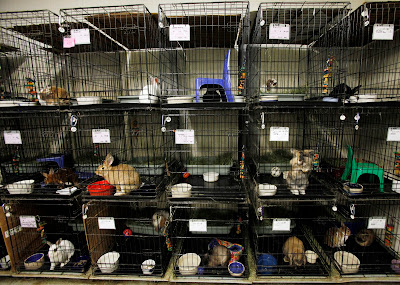
 If you are a first-time bunny parent, you will be far happier adopting a socialized adult rabbit who already knows how to deal with humans and is much easier to make friends with. Shelter and rescue personnel know and care deeply about the animals - breeders and petstore employees typically don't and the animals you get from them may be more inclined to health problems. In some cases they may also have been subjected to mistreatment; rescue/shelter volunteers will work with you to help you pick the best pet for you and your lifestyle, with the rabbit's best interests in mind. When you adopt an animal from a shelter, you are saving a life, giving a previously unhappy soul a chance at happiness, and are creating the space for the shelter to rescue yet another animal that desperately needs proper care and shelter
Love and Lightning Bugs,

It seems that for most people, an animal is perceived as a "good pet" if she shows affection in ways human beings can understand without much effort (e.g., lapsitting or coming when called), if she participates in games humans easily comprehend ("catch," "fetch," or "chase the string"), or if she makes an obvious effort to communicate vocally (barking to be let in or out, mewing for supper). People usually seem fairly sure these qualities cannot be expected in a rabbit, and hence, that rabbits would not make "good pets." Alternatively, some people expect such traits in all rabbits and may be disappointed in one who is unwilling or unable to comply with their expectations. For example, one of my rabbits, Claudia (a Lionhead/Flemish Giant cross), hates to be picked up, but it more than happy to lay down next to you and be petted.

The second question I get, "Are rabbits more like cats or dogs?" is a natural to follow the first. My usual response is, "Are people more like fish or cockatoos?" After all, rabbits are like rabbits, and the only way to find out what they are like is to live with one or more. You'll find that rabbits share a few characteristics with dogs, a few with cats, and a few with humans. They probably even share a few with fish and cockatoos. But mostly they're like rabbits, and learning what rabbits are like is part of the joy of living with them. The fact that this question, like the "good pets" one, is asked at all makes clear the human position that in order to be considered of value in our world, other species must conform to our notions of what is "good."
The implication that some animals (usually dogs and cats) are simply "better pets" than others rests on the assumption that in order to fit into our lives, all animals should resemble those to whom we are already accustomed. Such an assumption removes the responsibility for the relationship from the human being and places it solely on the animal. Although the rabbit is expected to comply with human expectations, all too often the human being never even considers complying with hers. But in almost every case, a wonderful new relationship is forged when you begin complying with the expectations of a rabbit. My other rabbit, Maylene (A mutt of sorts) has the tendency to throw objects about whenever she’s outside of her cage. This can be anything from a hairbrush or newspaper, to a full sized cowboy boot. But watching her toss around something, then run and binky with glee…there is nothing quite like it.

Do we expect too much or not enough? I hesitate to tell people not to expect their rabbits to jump up on their legs, leap into their laps, or lick their hands, because some rabbits do these things. But too many people expect such behaviors and express disappointment when their rabbits do not comply. None of the rabbits I live with currently do any of these dog-like things, but over the years I have discovered a range of interesting activities they engage in that the dogs and cats in my family never even thought about. Claudia may not jump into my lap, and she's more likely to bite my hand than lick it, but she manages to growl in annoyance while simultaneously cavorting with joy across the floor, and makes demands more effectively than any of my noisier critters. For instance, every time I walk by her cage, she places her paws on the bars and presents her head to be petted. If I refuse, or forget, to pet her, the cage door is soon rattling, shaking, and the floor being scratched in her anger. Maylene on the other hand, trails behind me like a puppy when she's loose in the house, and will even pull on my pant leg to let me know she's there. She'll also hop around my feet, in a circle, and expects me to circle her after. She's my follower, and Claudia is my runner.
 No small part of the problem lies in our use of the term "pet." After all, a pet is "one who is petted," implying passivity and ownership. We seldom call other human beings "pets," and most people would consider it an insult if we did. By using the term to describe animals we are diminishing their importance in our lives. We are denying their right to individuality and a lifestyle that may or may not include allowing us to fawn over them. On the other hand, a rabbit who is a companion is one who’s like our human friends, and is encouraged to develop the personality nature gave her and is appreciated for who she is.
So what should I say when people ask if rabbits are "good pets"? I don't want to assure folks that they are, because I know the implications of the phrase. On the other hand, if I hesitate and explain, they'll think I'm making excuses. They may be unable to see what is special about rabbits. Perhaps those of us who know, through experience, what rabbits are like should decline to answer these questions at all. Instead explain that rabbits make wonderful, exciting, intelligent companions for wonderful, exciting, intelligent people. After all, living up to the expectations of a rabbit takes a lot of work! Their type of person is adventurous, charmed by evidence of spunk and vigor, and willing to learn a new language, a new lifestyle, and a new code of behavior.
This brings me to another point, which is that rabbits are quite a lot of work. If you’re still interested in getting a rabbit after reading the above information, please seriously consider the following information before making a decision that will affect the life of a rabbit or two and every member in your household.
Housing
The best place for pets to live is indoors with their human families, and this applies to rabbits, too. Many bunnies today live as house rabbits, roaming freely throughout the home just like dogs and cats do. There are several reasons rabbits shouldn't live outdoors:
· Domestic rabbits are different from their wild relatives—they don't do well in extreme temperatures, especially summer heat.
· Even in a safe enclosure, rabbits are at risk from predators. Just the sight or smell of a predator can cause rabbits so much stress that they can suffer a heart attack and literally die of fear.
Whether your rabbit has free rein in your house or is confined to a "rabbitat," she needs a private space where she can feel safe and comfortable. There are several different housing systems for rabbits. Whatever kind you choose, make sure to keep it clean and well-stocked with hay, water, and the other necessities that make her house a home.
 Most rabbit cages sold in pet stores are too small. Your bunny needs more than just a few square feet for her home. If your rabbit is free to roam through the whole house or an entire room, a small cage like this may be ok as a base of operations. But if your rabbit is in her cage for extended periods of time, she'll need a much larger place to live. A rabbit's cage should be a minimum of five times the size of the rabbit. She should be able to completely stretch out in her cage and stand up on her hind legs without bumping her head on the top of the cage. Look for larger, multi-level rabbit homes offered by some pet supply stores and specialty online retailers. These cages give your bunny a lot of room to move around. Whatever type of cage you get, make sure that the floors and resting platforms are solid, not wire, which can hurt your rabbits feet.
Not all rabbits need a traditional cage. Another option is to use a puppy pen or x-pen to contain your rabbit. As long as the pen contains the appropriate amenities, that will work just fine.
If you're more of a do-it-yourselfer, you can easily build a home for your rabbit. Homemade cages are easy to make with a minimum number of tools. If you're willing to put in the time, you can build a very large, very nice cage for a fraction of the cost of purchasing one.
If you have a large home with many rooms, you can even devote an entire room to your rabbits. For starters, avoid flooring that's too slick for rabbit feet, like linoleum. Textured tiles usually work well and are easy to clean. Carpeting is fine too, if your rabbits have good litterbox habits and you can trust them not to chew the carpet. Replacing a regular door with a transparent door or Dutch door can allow you to keep an extra eye on your bunnies.
In any home, it's important for a rabbit have a secluded place to hide. A cardboard box with a hole cut in it will be fine (staples and tape removed for safety). Rabbits usually sleep during the day and night, becoming playful at dawn and dusk, so they may use this box as a bedroom.
Also, don't forget the necessities, like one or more litterboxes with litter, hay, and water, and plenty of great chew toys to keep your bunny stimulated.
Your home also needs to be prepared. Rabbits have a tendency to chew on furniture, nibble on or through cords, eat houseplants (poisonous or not) and may have potty accidents. It is up to you to protect any rabbit coming into your home as well as your belongings. We call this rabbit-proofing your home.
Children
 Parents should always be the primary care taker of any animal family member. Small children and rabbits do not make a good combination. Young children do not have the dexterity to handle a rabbit safely and securely. Often, when small children attempt to lift and/or carry a rabbit, one or both end up hurt. I do not recommend children under the age of nine to be allowed to handle rabbits. All too often, parents purchase a rabbit for a child family member; Easter is one of the heaviest times of the year for this. The child is excited, the rabbit is terrified, the child looses interest, the rabbit is ignored and unwanted and the parents end up disappointed and resentful. It is the parent's responsibility, regardless of the situation, to ensure that ALL family members are safe, happy, healthy, cared for and loved.
Additional Animal Family Members
 Any introductions should be done slowly and with strict supervision. Some animals should not ever be considered for introductions. One such animal is a ferret. They are precise, accurate, and avid hunters of rabbits. Dogs should never be left alone with a rabbit. The most friendly, calm canine's instincts to hunt or herd could be awakened. Even in play, the rabbit could end up seriously injured or worse. Introducing a new rabbit with a current rabbit family member needs special consideration beyond a slow introduction. Guinea Pigs, cats and birds are some possible animal family members, but consideration must be given to their personalities and behaviors. A bird imitating a hawk or being excessively noisy can cause stress to a rabbit , which will affect the rabbit's health and personality. Rabbits, like people, have very distinctive personalities along with likes and dislikes.
Veterinary Care
You should locate and have onboard a rabbit knowledgeable vet in your area before welcoming a rabbit into your family. Emergencies are always unexpected and the best way to handle them are to be prepared as much as possible ahead of time! You could check the National House Rabbit Society's list of recommended vets on their web site at www.rabbit.org or check your local Yellow Pages. Regardless of your choice, you will need to interview any potential vet. Locate at least a couple of perspective vets and schedule a time to actually go in and meet them. Ask a lot of questions and don't hesitate to ask detailed, personal ones. Once you have made a decision. It is also a good idea, once adopting a rabbit into your family, to schedule an appointment with your vet so everyone can get familiar with one another and to set up a spay or neuter if your rabbit isn't already altered.

Allergies
If anyone in the household has fur or hay allergies, rabbits will not be an acceptable addition to your family. If you are unsure, it would be in everyone's best interest to visit a local shelter to see whether or not any allergies are triggered.
If after considering the previous information you feel a rabbit would be an appropriate and wonderful addition to your family, please consider adopting from a local shelter or rescue organization. There are many wonderful rabbits waiting in shelters hoping for a loving, adoptive family of their own.

Why adopt a bunny? For every pet you buy from a pet store or breeder, a pet in a shelter is euthanized. Unfortunately, that is the simple math. There are only so many homes for bunnies. Shelters are overflowing with unwanted and discarded pets. There is only so much they can do without your help. Supporting pet stores and breeders only contributes to the problem. Sadly, even rescuing from a pet store simply encourages them to order more from a breeder.
If you're not yet ready to adopt, please consider fostering a bunny or perhaps a bonded pair - that also gives us the ability to rescue another bunny (or two) that desperately need our help!!

Adopting an adult animal means many things:
· They have already gone through their hormonal changes
· Their behavior is already known and more consistent than when they are growing babies
· They have already been through a hard time and will likely be very appreciative of a second chance
· There is a special reward you get from saving a bunny as opposed to just getting a cute novelty on a whim
· Rabbits in shelters and rescues have usually been socialized by volunteers as part of the rehabilitative process
· Adoptable bunnies are already spayed or neutered and so are far less inclined to certain health and behavioral problems
 If you are a first-time bunny parent, you will be far happier adopting a socialized adult rabbit who already knows how to deal with humans and is much easier to make friends with. Shelter and rescue personnel know and care deeply about the animals - breeders and petstore employees typically don't and the animals you get from them may be more inclined to health problems. In some cases they may also have been subjected to mistreatment; rescue/shelter volunteers will work with you to help you pick the best pet for you and your lifestyle, with the rabbit's best interests in mind. When you adopt an animal from a shelter, you are saving a life, giving a previously unhappy soul a chance at happiness, and are creating the space for the shelter to rescue yet another animal that desperately needs proper care and shelter
There is no greater joy than ending a life of suffering...without ending a life.


.jpg)


