Showing posts with label Animal Fun Fact. Show all posts

Tuesday, March 11, 2014

This is Why People Think I'm Weird

You know, I thought today was going to be great. I got a package for a gorgeous review item I had been waiting for, everyone in the house was in a good mood, I got to sleep in late, hell, it was going great!

Then a giant branch fell off the tree above my driveway, and dented to hood of my truck.

So while the hubby went outside to rant and rage and take his anger out on the tree, I sat down and did what I always do to make myself feel better.

I Bing pictures of the Pootoo Bird.


When you're flooded with page after page of the derpiest looking bird in existence, who either looks like he's extremely upset by something, or he wants to eat your soul, well...your day just can't be bad after that.

I mean, look at him.

Love and Lightning Bugs,
  Photobucket

Sunday, February 16, 2014

Saying Goodbye

I know I normally post about my rabbits, both the good and the bad, but today, I received some pretty upsetting news.

Before I get to that though, I think some backstory is in order.

You see, like every other teenager on the planet, the human known as me at 18 was a fucking nightmare to deal with. I wasn't nearly as bad as some of the horror stories I'm sure you've heard about other teens, but I was no angel either. I had good friends, a job, an close knit family, and an attitude that would make you wonder how my mother didn't chain me in a dungeon.

I got in a pretty bad relationship my Senior year in High School, with a guy who I thought was my Prince riding in on a white horse to save me.

I was wrong.

He hit me, he slapped me, he pushed me around, he forced me into things, and made me feel like the lowest of the low when he was around, or when I did something he didn't like. It was emotional and physical abuse, and once my parents found out about just how bad things had gotten, they shipped me off to Kansas to live with my SUPER conservative Christian Aunt.

I love my aunt,I really do...but at that point in my life, I hated pretty much everyone. Well, my aunt never married or had kids, but she always had cats. As far back as I can remember, she's always had a pair of them. For the extent my "trial 1 month stay" at her home, she had a spazzy calico named Callie, and a talkative tabby named Katie.

You should know by now, just how much I love animals. I tried desperately to form a connection with these cats, but both simply snubbed their noses at me. For the first week, I was subjected to a drastic change in my diet (I was put on vitamins and all that super fun supplement junk...ick), a change in my wardrobe, all my dearly cherished items were riffled through, and all my music and books were put away as well. It was hell, pure and simple.

I felt alone, I felt like an outsider, and I was seething.

And then, one afternoon in my second week there, I was sitting on my bed writing, and the next thing I knew, there was a massive ball of grey fluff on the bed with me. Katie sniffed my hand, looked at me a couple times, then plopped on my lap for the remainder of the evening. After that she was a constant follower, and a happy friend. I still don't know what exactly happened, but before I knew it, I was getting a job in Kansas, choosing to stay there, I realized just how much abuse I had suffered at the hand of my ex, I was singing and drawing and painting again, I was focusing on my photography and writing, my head sorted itself all out, and I was pretty content.

I learned to live again. All because a fat cat decided that I was an ok human being.


And then, today, I learned that the fat cat who was so crucial to my mental healing passed away from kidney failure. She was 12 years old, and quite the chirpy thing when she got to talking. Her favorite place was a lap, or cuddled next to one on the couch. She had beautiful green eyes, and dainty black paws. She was never in a bad mood...and she was the one thing I needed most when I felt the world was falling apart around me.


Thank you Katie. I love you, and I hope we get to meet again at the rainbow bridge one day...

Love and Lightning Bugs,
  Photobucket

Tuesday, September 17, 2013

I May Be Broken, But I Mean Well

Some days, my life is so difficult that I just want to cry. I don't mean that my life in general is difficult, because it's not. It's actually pretty damned amazing in most respects. What I mean is that living in my body day to day can make me so worn out mentally and physically, that I just want to fall asleep for a few years, just to feel normal for once.

I may not look too bad on the outside, but if you could see just how messed up I am inside, you would cringe and run in fear.

Not only do I have an awesome chronic disease that makes planning a meal a nightmare, but I have such debilitating anxiety problems that the only way to get by in social situation is to cling to the resident pet like it's the last life boat on the Titanic.

On a good day, I feel like a normal human being. I don't have any tummy issues, I can eat whatever I want, and I can mingle with people without spinning the ring on my finger so hard and fast that I bruise. On a bad day though, it's almost not even worth getting out of bed.

No matter what I eat, be it steamed rice and veggies, or a greasy cheeseburger, I get sick. And not just once, no...that would make being me too simple. I get sick every 10-45 minutes all day long. There are only so many times you can excuse yourself from class before you just have to pack up your stuff and not come back. Maybe if my Crohn's was a bit more predictable, this wouldn't be too much of an issue...but it's not.

I can eat something for years, and it's perfectly fine. Then one day, my guts will go NOPE, and that food is off the menu for a month, until I'm forced to try it to see if it's edible again. Generally, I can eat it again, until my guts have the same reaction, and we start the cycle all over again. Also, trying new food is pretty much out of the question. So not only does the food have a pretty good chance of making you sick all day, but it's the same thing you have eaten for years.

Tummy issues are semi-controllable, because I can plan and think ahead. The anxiety issues however, are so far beyond my control that it's painful sometimes.

I don't like crowds. I don't like parties. I don't like gatherings of more than 3 people generally. One a side note, whoever thought "small talk" was a good idea, need to be drawn and quartered, and his left over pieces fed to the fucking crows. Small talk is what gets me in trouble...generally it goes like this for me.
-----------------------
Stranger: So, this party is great. How do you know (person who the party is for)?

Me: *Momentary deer in the headlights look* Umm....they're friends with my friend. I'm just here for emotional support. You know, in case the zombie apocalypse starts while we're here and she has to shoot her friend in the face.

Stranger: *blank stare*

Me:  Some of us are ready, some of us are zombie h'orderves. It's the circle of life.

Stranger: So...these little bacon wraps are pretty nice.

Me: Did you know that a pig's orgasm lasts 30 minutes, or more?

Stranger: *Just turns and walks away*
-----------------------
THIS IS WHY I CAN'T DO SMALL TALK.

My brain goes "Say something! You look crazy just standing over here by yourself. SAY SOMETHING." It's at that point, that out of the anxiety of looking like a crazy person, I end up saying the first thing that comes to mind...which is almost always a horrible horrible idea...and generally ends up making me look like a crazy person. Then I have a near panic attack over that little snafu, and suddenly word vomit comes exploding from my mouth in an attempt to save face...which leads to an even worse situation in the end.

See, this is why I can't have nice things or make new friends.

Yes, this is my dog holding my hand. Pippin loves all his people.

So in the end, I tend to just sit out of the way, clamping my mouth shut, and playing with the family pet. Because the dog doesn't care that you're a damaged person, he just wants you to scratch his belly. The cat may judge you, but he's a cat, and I've come to terms with feline snootyness. An animal is more than happy to stay with you when the room seems so small you can't breathe. They're always willing to give you a nuzzle or a kiss on the cheek when you're crying in the bathroom because you just made a fool of yourself in front of someone you may never meet again.

Like I said...some days, I really hate being me.

Love and Lightning Bugs,
  Photobucket

Wednesday, August 28, 2013

Everything You Never Needed to Know about Dolphins

Well, the first week of classes is only half over, and I am already tired and overtaxed in the "working my brain" department. So what did I do with 5 chapters of reading to do before tomorrow?

Look at Youtube videos of course.

I found this little gem, and am now scarred for life. I was told by a friend of mine that this whole series is sometimes shown in College classes....why? I have no fucking clue.

Seriously, it's so weird, I had to keep watching more and more and more....and then it was 6 hours later and decided that reading is overrated anyway. Seriously....watch this. Make your friends watch this, spread the horrible, life-altering, cursed thing...I've already subjected the boyfriend, my brother, and many other female friends to it...who intern have spread it on and on, like the plague it is.

I won't tell you what it's about, but I'll give you a hint. You will never think of dolphins the same way EVER AGAIN.

Seriously, do not have your kids in the room, in the house, in the universe when you watch this.


Love and Lightning Bugs,
  Photobucket

Tuesday, February 19, 2013

Larger than Life Animals of the Past

Since the last post I did about extinct animals when over so well, I thought I would try it again! Below are a few of my favorites.

Doedicurus (Glyptodon)
Imagine a bony plated armadillo 12 feet in length weighing as much as a Volkswagen Beetle with a club of spikes on its tail and that's what Doedicurus (Glyptodon) was like.

Doedicurus fossils have been discovered in North and South America where it flourished during the Pleistocene, becoming extinct at the end of the Pleistocene Glaciation roughly 10,000 years ago. Doedicurus is one of the more well known Pleistocene megafauna and it is possible that early native human populations hunted them and utilized the animal as a source of food, as well as using the shells of dead animals as shelters in inclement weather.


Doedicurus shell was covered by more than 1,000 2.5 cm-thick bony plates, called osteoderms. Each species of glyptodont had its own unique osteoderm shell type and pattern. With this protection they were armored like turtles. But unlike most turtles, glyptodons could not withdraw their heads, but instead had a bony cap on the top of their skull. Even the tail of Glyptodon had a ring of bones for protection. Such a massive shell needed considerable support, which it had in features such as fused vertebrae, short but massive limbs, and a broad shoulder girdle.

The nasal passage was reduced with heavy muscle attachments for some unknown purpose. Some have speculated that the muscle attachments were for a proboscis, or trunk, much like that of a tapir or elephant. Most animals with a trunk, however, have nasal bones receding back on the skull, and glyptodonts do not have this feature. The lower jaws were very deep and helped support massive chewing muscles to help chew the coarse fibrous grasses and plants that can be found along river and lake banks.


Indricotherium transsouralicum
The Indricotherium, also know as Baluchitherium and Paracaratherium, was a gigantic long-necked, hornless rhinoceros that lived in Asia during the Oligocene and early Miocene eras (from about 37 million to 25 million years ago). It looked like a cross between an elephant and a horse.

Most paleontologists agree that the Indricotherium was the largest land mammal to have ever walked on earth. Its skull alone measures from 15 to 33 tons standing 18 feet at the shoulder. This is about 4 or 5 times larger than a modern elephant. Their immense size would have made them virtually inaccessible to predators.


Like the rhinocerous, this extinct mammal had 3 toes on each foot and probably had a prehensile upper lip. Along with this and its four tusk-like teeth, two on bottom and two on top, the Indricotherium's mouth would have been perfectly adapted to stripping leaves from their branches. They probably lived in herds which roamed through an open woodland environment, their long necks making them well suited for browsing and foraging the tops of trees for food. They would have filled a niche in the ecosystem similar to that of today's giraffes.

Giant Ground Sloth (Eremotherium laurillardi)
There are four species of extinct ground sloths, the most spectacular of which is Giant Ground Sloth (Eremotherium laurillardi). This animal was huge and weighed as much as a mammoth, could rear up as high as a giraffe and had claws the size of a man's forearm. It lived around 130,000 years ago.


Giant ground sloths were some of the strangest mammals ever to have lived and resembled no other animal. Although related to modern tree sloths, they lived on the ground and rivalled the mammoths in size. Their remarkable claws were up to 50cm long. Massive hind quarters gave way to much slimmer shoulders and a tiny head.

They were herbivores and ate through all parts of plants and trees, fruits, leaves and twigs. It used its giant tail to brace it upright, while feeding on large amounts of twigs and leaves. The oddly balanced anatomy and massive claws of the giant ground sloths gave them a strange walk. From footprints in South America we know that at least some of the time they walked on just their hind legs.


Carcharodon (or Carcharocles) Megalodon
Carcharodon megalodon was a GIANT shark that lived in prehistoric times 25 to 1.6 million years ago, during the Miocene and Pliocene. It was the top predator of its time and is the largest carnivorous fish kown to have ever existed.


Scientists estimate Carcharodon megalodon was 40 - 100 feet long and could have weighed as much as 50 tons. This is at least two or three times as long as the great white shark of today. Giant teeth from this shark have been found that are the size of a person's hand. Since sharks skeletons are formed from cartilage rather than bone, no fossilized parts other than it's teeth have been found, so its overall appearance and size are based on inferences from examining shark teeth, dermal scales, and calcified vertebrae to draw their conclusions about this very successful group of vertebrates. Since Megalodon's teeth are very similar to the teeth of the Great White Shark (but bigger and thicker), it is thought that Megalodon may have looked like a huge, streamlined version of the Great White Shark.

Megalodon's diet probably consisted mostly of whales. It may have hunted using the same stealthy technique that today's Great White Sharks have been known to employ to capture pinnipeds, stalking their prey from deeper waters and then swimming up at full speed to deliver a massive bite.


Why did the Giant "Mega-Tooth" Shark become extinct? Perhaps the reduction in ocean temperatures in the mid-Pliocene affected this species, which preferred warm waters. Another possibility is that their favored prey species, such as the baleen whales, had begun to migrate to colder waters where the giant sharks could not thrive.


Aepyornis Maximus
A bird taller than a basketball hoop!


Aepyornis maximus, also known as the elphant bird, was the world's largest bird, believed to have been over 10 feet tall (3 metres) and weighing close to half a ton (400 kilograms (880 lb). It's eggs are the world's largest eggs at 88 cms.

Like the cassowary, ostrich, rhea, emu and kiwi, the Aepyornis could not fly. Birds that have lost the ability to fly belong to a group of birds called ratite.


It is often believed that the extinction of the Aepyornis was an effect of human activity. Studies have found remains of eggshells among the remains of human fires. Animals arriving with the human colonists, such as rats and dogs, may also have preyed upon the eggs of the ratite population and reduced their viability. Humans may also have hunted adult birds into extinction.

Want to see more fun prehistoric creatures? Then leave me a comment below!

Love and Lightning Bugs,
  Photobucket

Friday, February 15, 2013

Amazing Sea Creatures

It's been a really rough week here.

The hubby's mom was in a car accident on Sunday night, and has been in the hospital ever since. Due to that, the blog has a taken a backseat. But, I'm free for today, and I want to start blogging again!

I often talk about animals on this blog, but they're usually animals who live on the land in some way. The deep sea offers it's own array of distinct and weird creatures...and I think it's time to meet some of my favorites.


 The Dumbo Octopus


The Dumbo octopus, named for its pair of prominent fins, is much smaller than its elephant namesake—it's only about 8 inches (20 centimeters) long—and dwells near the ocean floor at depths of up to 1,310 feet (400 meters). Like other octopuses, it has eight arms, but they are webbed and serve as swimming aids, supplementing the flapping of the giant fins.


The Japanese Spider Crab


This is the largest known arthropod; fully grown it can reach a leg span of almost 4 m (13 ft), a body size of up to 37 cm (15 inches) and a weight of up to 20 kg (44 lb). The crab’s natural habitat is on the bottom of the Pacific Ocean (some 300 to 400 m deep) around Japan, where it feeds on dead animals and shellfish. It is believed to have a life expectancy of up to 100 years


The Tripod Fish


The tripod fish gets its name from the three extra-long fins extending from its body. It uses these like stilts to stand on the bottom, keeping its body just above the surface of seafloor. Then it sits and waits to ambush any passing prey. When the prey comes within range, the tripod fish pounces on it.


The Gulper Eel


The gulper eel has huge, pouch-like jaws. These can open wide enough, and its stomach stretch far enough, for it to swallow fish much bigger than itself. The gulper eel can unhinge its jaws, opening its cavernous mouth even wider. This fish grows to a length of 2 ft (60 cm). It is found at depths below 6,500 ft (1,998 m).


Want to see more? Let me know in the comments!

Love and Lightning Bugs,
  Photobucket

Sunday, February 10, 2013

10 Extinct Animals in the Last 150 years


Mankind has the honor of quite possibly being the most destructive force to ever hit mother nature. This list looks at some of the more recent, probably lesser known extinctions that humans have lent a helping hand to. Whether by over hunting or over population, driving a species to extinction is nothing to be proud of and it’s certainly not slowing down. This is a heartbreaking reminder that one day, your children might not know what a Panda, Sea Turtle, or Siberian Tiger look like. We have to protect the species we have so endangered.

10.) Thylacine


Commonly known as the Tasmanian Tiger, the Thylacine was the largest known carnivorous marsupial of modern times. Virtually wiped out in the wild due to constant hunting (they were thought to be a threat to sheep and other small farm animals) and the encroachment of humans on their already limited habitat the Thylacine was finally recognized as being in danger of becoming extinct in 1936, too little, too late as that same year the last Thylacine, named Benjamin, died on 7 September as the result of neglect - locked out of its sheltered sleeping quarters and exposed to freezing temperatures at night in Hobart Zoo, Tasmania. 60 years later there are still claims of sightings, but all are yet to be confirmed.

9.) Quagga


The Quagga was a southern subspecies of the Plains Zebra. It differed from other zebras mainly in having stripes on the head, neck, and front portion of its body only, and having brownish, rather than white, on its upper parts. The last free Quaggas may have been caught in 1870. The last captive Quagga, a mare, died on 12 August 1883 in Amsterdam Zoo, where she had lived since 9 May 1867. It was not realized that this Quagga mare was the very last of her kind. Because of the confusion caused by the indiscriminate use of the term “Quagga” for any zebra, the true Quagga was hunted to extinction without this being realized until many years later. The Quagga became extinct because it was ruthlessly hunted down for meat and leather by South African farmers, also they were seen by the settlers as competitors, like other wild grass eating animals, for their livestock, mainly sheep and goats.

8.) Passenger Pigeon


The story of the Passenger Pigeon is one of the most tragic extinction stories in modern times. As recently as around 200 years ago they weren’t anywhere near extinction. In fact, they were actually the most common bird in North America, and some reports counted single flocks numbering in the billions. When a flock would pass overhead, sometimes the sky was dark for over an hour as they passed.However, Pigeon meat was commercialized and recognized as cheap food, especially for slaves and the poor, which led to a hunting campaign on a massive scale. Furthermore, due to the large size of their flocks, the birds were seen as a threat to farmers. The last Passenger Pigeon, named Martha, died alone at the Cincinnati Zoo at about 1:00 pm on September 1, 1914.

7.) Golden Toad


The first record of the Golden Toad was by herpetologist Jay Savage in 1966. The toad, recognized by its brilliant golden orange color, was native to the tropical cloud forests which surround Monteverde, Costa Rica. None have been seen since 1989. It last bred in normal numbers in 1987, and its breeding sites were well known. In 1987, due to erratic weather, the pools dried up before the larva had matured. Out of potential 30,000 toads, only 29 had survived. In 1988, only eight males and two females could be located. In 1989, a single male was found, this was the last record of the species. Extensive searches since this time have failed to produce any more records of the golden toad.

6.) Caribbean Monk Seal


The Caribbean Monk Seal was the only known seal which was native to the Caribbean Sea and the Gulf of Mexico. It is also the only species of seal to go extinct directly due to human causes. The Caribbean monk seal was the first New World mammal to be discovered by Columbus and his company on the coast of Santo Domingo in 1494. It appears in the account of Columbus’ second voyage to America. Columbus promptly ordered his crew to kill eight of the animals, which he called “sea-wolves”, for food, paving the way for exploitation of the species by European immigrants who came in his wake. Since then, the once abundant seals have been hunted for their oil and slaughtered by fishermen, who regarded the animals as competitors. It was officially declared extinct just a few years ago, on June 6th, 2008, although the last recorded account of the species was made at Serranilla Bank between Honduras and Jamaica in 1952. Like other true seals, the Caribbean Monk Seal was sluggish on land. This, along with its lack of fear for man, unaggressive and curious behavior, as well as human hunting, and early habitat exclusion by humans throughout their range may have dramatically speed up their decline and likely contributed to its demise.

5.) Pyrenean Ibex

The Pyrenean Ibex has one of the more interesting stories among extinct animals, since it was the first species to ever be brought back into existence via cloning, only to go extinct again just seven minutes after being born due to lung failure. The Pyrenean Ibex was native to the Pyrenees, a mountain range in Andorra, France and Spain. The Pyrenean ibex was still abundant in the fourteenth century. The Pyrenean ibex’s population declined due to a “slow but continuous persecution” and disappeared from the French Pyrenees and the eastern Cantabrian mountain range by the mid-nineteenth century. Its situation has been critical since the beginning of the 20th century, when it was estimated that the Pyrenean population in Spain numbered only about 100 individuals. Since the beginning of the 20th century, the population never rose above 40 individuals. In 1981, the population was reported to be 30. At the end of the 1980’s the population size was estimated at 6-14 individuals. The last naturally born Pyrenean Ibex, named Celia, died on January 6th, 2000, after being found dead under a fallen tree at the age of 13. That animal’s only companion had died just a year earlier due to old age.

4.) Bubal Hartebeest


Although it once roamed throughout Northern Africa and the Middle East, the deep-rooted mythology (once domesticated by the ancient Egyptians as a food source and for sacrificial purposes) which surrounded the animal was not enough to save it from European hunters who began hunting them for recreation and meat. People who resided in Morocco shot these animals for fun, and for hunting, which wiped large herds of them out. Many Hartebeests were captured and were kept alive (e.g. in the London Zoo from 1883 to 1907), but they eventually died out. The last Bubal Hartebeest was probably a female which died in the Paris Zoo in 1923.

3.) Javan Tiger


Javan Tigers were a subspecies of tigers which were limited to the Indonesian island of Java. In the early 19th century Javan tigers were so common, that in some areas they were considered nothing more than pests. As the human population increased, large parts of the island were cultivated, leading to a severe reduction of their natural habitat. Wherever man moved in, the Javan tigers were ruthlessly hunted down or poisoned. Natives carried much of the hunting out, a surprising thing since they considered the tiger a reincarnation of their dead relatives. The last specimen to have been seen was sighted in 1972, although there is evidence from track counts that the animal had lingered into the 1980’s. The last track counts to yield evidence of the tigers was held in 1979, when just three tigers were identified. The leading cause of their extinction was agricultural encroachment and habitat loss, which continues to be a serious concern in Java.

2.) Tecopa Pupfish

The Tecopa Pupfish was native in the Mojave Desert, in Inyo County, California, United States of America. This fish subspecies was originally found only in the outflows of North and South Tecopa Hot Springs. It was first described by Robert Rush Miller in 1948. Its decline began in the early 1940's when the northern and the southern spring which were about 10 yards apart were made into canals and bathhouses were build. The popularity of Tecopa Hot Springs in the 1950's and 1960's led to the building of hotels and trailer parks in that area. By 1981 the Tecopa Pupfish was officially de-listed by the United States Fish and Wildlife Service and it became the first animal which was officially declared extinct according to the provisions of the Endangered Species Act of 1973.

1.) Baiji River Dolphin


The Baiji population declined drastically in recent decades as China industrialized and made heavy use of the river for fishing, transportation, and hydroelectricity. As China developed economically, pressure on the river dolphin grew significantly. Industrial and residential waste flowed into the Yangtze. The riverbed was dredged and reinforced with concrete in many locations. Ship traffic multiplied, boats grew in size, and fishermen employed wider and more lethal nets. Noise pollution caused the nearly blind animal to collide with propellers. In the 1970's and 1980's, an estimated half of Baiji deaths were attributed to entanglement in fishing gear. Only a few hundred were left by 1970. Then the number dropped down to 400 by the 1980's and then to 13 in 1997 when a full-fledged search was conducted. The dolphin was declared functionally extinct after an expedition late in 2006 failed to record a single individual after an extensive search of the animal’s entire range.


So please remember, that our ecosystems and our animal species are delicate, and they will more often need our help to survive. Humans drove these amazing creatures to extinction through pollution, over-hunting, and habitat loss...we have to start making things right again.

Love and Lightning Bugs,
  Photobucket

Monday, January 28, 2013

The Loyalty of Harvey


As you all know, I am an avid animal lover. I posted a while back about the Loyalty of the Horses used during the Civil War, so I though it was only fitting to continue posting such stories of animal heroism and devotion. I plan on doing these kinds of posts from time to time, so I hope you enjoy them!

One canine “volunteer” who attracted considerable notice during his service was Harvey, a bulldog who went to war with the 104th Ohio Volunteer Infantry in the late summer of 1862.

Harvey was taken to Vick’s Studio in Alliance, Ohio, probably about the time the regiment was mustered out of the service to have his carte de visite photograph taken.


The 104th was recruited in Northeast Ohio.  The small town of Wellsville, in Columbiana County, provided the recruits for what was to become Company F.  The company was home, according to the regimental historian, to “an undue proportion of ‘toughs’ and ‘deadbeats,’” as well as Harvey and another dog, “that became the pets of the regiment.” Harvey was “an aristocrat,” with more time in the army than most of his regularly enlisted companions.  He came to the regiment with First Sergeant Daniel M. Stearns, who earlier had served nearly fourteen months in the Eighth Pennsylvania Reserves.  Harvey had accompanied his master’s Pennsylvania outfit to the Virginia Peninsula and, according to one source, was wounded there.  By November 1862 Sergeant Stearns had been promoted to second lieutenant, and Harvey was sporting a collar with a brass plate bearing the legend: “I am Lieutenant D.M. Stearns’ dog; whose dog are you?”

Harvey and the men of the 104th spent a long year marching the dusty (or muddy) roads of Kentucky and East Tennessee, compared by many in the unit to Washington’s winter camp at Valley Forge.


On February 14, 1864, Captain William Jordan of Company K wrote home to his children describing the various pets accumulated by the regiment. Harvey and another dog named Colonel were described as “veteran soldier dogs” who “go in any of the tents that they want and lay down at night or stand with the sentinels on guard.”  A third dog, Teaser, had been acquired early in 1864 by other enlisted men.  Teaser or Colonel may have been “the blue pup” referred to in Private Nelson A. Penney’s 1886 regimental history.  It is not surprising that some referred to the unit as the “Barking Dog Regiment.”

Harvey, who apparently had a taste for music, posed with the 104th’s coronet band.  It seems likely that this photograph was made at Cleveland, Tennessee, in May 1864 and that the cameraman was Thomas Sweeny of Cleveland, Ohio.  Western Reserve Historical Society.


Lieutenant Colonel Oscar Sterl was the proud owner of a pet squirrel that had the run of the camp and would even “nibble at the ears” of Harvey and Colonel.  Teaser, ignoring the squirrel’s status as a pet, attacked it and was only stopped by Harvey’s intervention.  He carefully grabbed the squirrel in his mouth and carried it to safety.  The rescue  proved unavailing, as the squirrel died of fright shortly after being released.  Other mascots included two raccoons and another squirrel who was kept secured by a tiny chain.

During the summer of 1864, the regiment participated in the Atlanta campaign.  Near Kennesaw Mountain, Harvey was wounded and captured.  The next day, still defiant, he wasreturned under a flag of truce.  From that point on Harvey was the most honored pet in the regiment. On November 18, 1864, Private Adam Weaver of Company I wrote to his brother in Ohio that “Old Harvey” had paid him a visit while on picket duty. Weaver speculated that perhaps he smelled more like a dog than the boys of Company F.  Weaver also recounted that during the soldiers’ campfire sing-alongs, Harvey would bark and move side to side.  “My idea is that the noise hurts his ears,” Weaver explained, “as it does mine!”

Less than two weeks later, Harvey survived the bloody battle of Franklin, Tennessee, where the 104th held a crucial position.  Harvey was present with Company F throughout the slaughter of the Confederate assaulting columns.  Protected by their hastily constructed earthworks, the 104th still suffered sixty casualties, nearly one-fifth of those present.  The regiment captured eleven enemy battle flags.

When members of the 104th Ohio Volunteer Infantry gathered for the obligatory group photograph at their 1886 reunion, they placed Harvey’s picture in the front row.  Massillon Museum.


Harvey’s part in the subsequent Battle of Nashville is unknown, but casualties in the 104th ’s brigade were extremely light.  His original owner, Lieutenant Stearns, had less luck than most.  While serving as an aide to Brigadier General James Reilly, he was severely injured when his horse fell in jumping the Confederate entrenchments.  In January 1865 the 104th was transferred to North Carolina.  During this trip Harvey and the regiment lost a companion, when the blue pup “tumbled off the train” near Cincinnati.  By early summer the war was over, and the men of the 104th had returned to their homes.

Harvey’s subsequent career is lost to history. Lieutenant Stearns finished the war as a captain of Company F.  He was granted a pension for his Nashville injury and eventually became insane, resulting in his confinement in the Northern Ohio Insane Asylum, where he died in 1890.  Although not much past middle age at the time of his death, there is no doubt that he had survived by many years the Yankee war dog who joined the army with him. 

Love and Lightning Bugs,
  Photobucket

Thursday, January 10, 2013

Are you Ready for a Disaster?

It may only be early January, but here in Kansas, that means Tornado season is coming on quick! Last year we had our first tornado of the season in February, and I was unprepared when the sirens went off. This year, I'm making sure I have everything I need BEFORE the sirens go off. But, the question is, are YOU ready for an unexpected tornado if it comes knocking? 

Image from billyunderscorebwa on Deviantart

Around here, severe storms hit more often at night. Which means that spotting a tornado on the ground is much harder, and that the time between the sirens going off and a tornado hitting your city can be slim to none. In February, we had no watches or warnings, just the sudden blaring of the sirens. It was 9 o'clock at night, and the rain was pounding so hard that it soaked through my thick Carhartt coat in about 30 seconds. The wind was blowing so hard I was knocked off balance four times in the 100 feet it took to run to the storm shelter. Every minute we took to gather supplies and pets, could have cost us our lives. So what's the best option for you in a situation where every second counts?


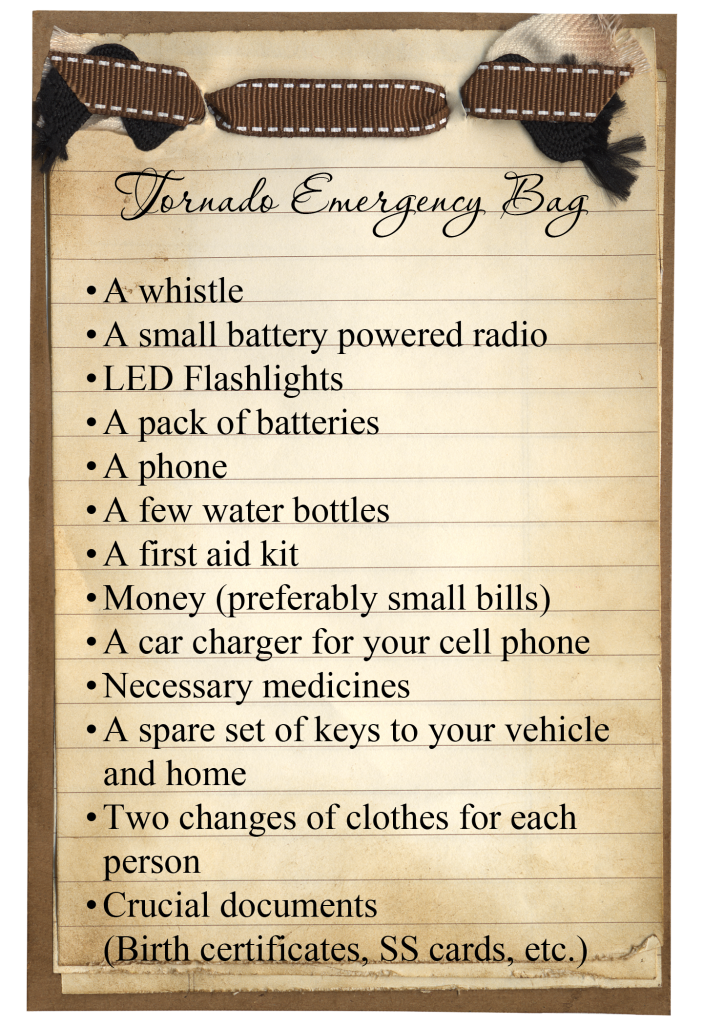
 A well supplied Tornado Emergency Bag, that you can grab and go!

If you don't have a basement, this is what I suggest using. It takes up very little room in a closet with you, and is easy to keep stocked at all times, as well as grab in a high stress situation. A well stocked bag is key! I use a large messenger bag I had laying around, and keep it packed at all times, except when I'm rotating out supplies. Here's a list of the things I keep in my kit.


I received an emergency flashlight radio for Christmas, and it too has gone into my kit! You can find a great list of them HERE. A whistle is necessary in any kit, as it helps people find you if your shelter is buried under rubble. Small LED flashlights can often be found for just over a dollar in most checkout lines at the grocery store, and are brighter than normal flashlights. I keep an average of three in my kit, as well as one in my camera bag.

On that note, I keep anything I would be heartbroken to lose in an easy to reach place. For instance, all my jewelry is in a small chest on my computer desk, and all my critical paperwork is kept in a folder on my desk as well. Since the desk is right next to the door, it is easy to grab them quickly, stuff them in the bag, and go! I also keep my camera packed in its bag at all times, unless I'm using it. That bag, as well as the case to my laptop, sit on the floor next to the same desk. It takes me 30 seconds to pack my laptop now, so that is more time saved in a hurry! All the important cords to any electronics I take are also in my camera bag or laptop case, so I don't have to worry about that.

But what about when you don't have to worry about just yourself?


We have two rabbits in the house, and unlike dogs or cats, they are NOT easy to just grab and run with. They have special needs that other pets don't, and attitudes to match! As much as they can be a pain, I love my bunnies more than life itself, so there is no question that I take them into consideration when making my Tornado plans.

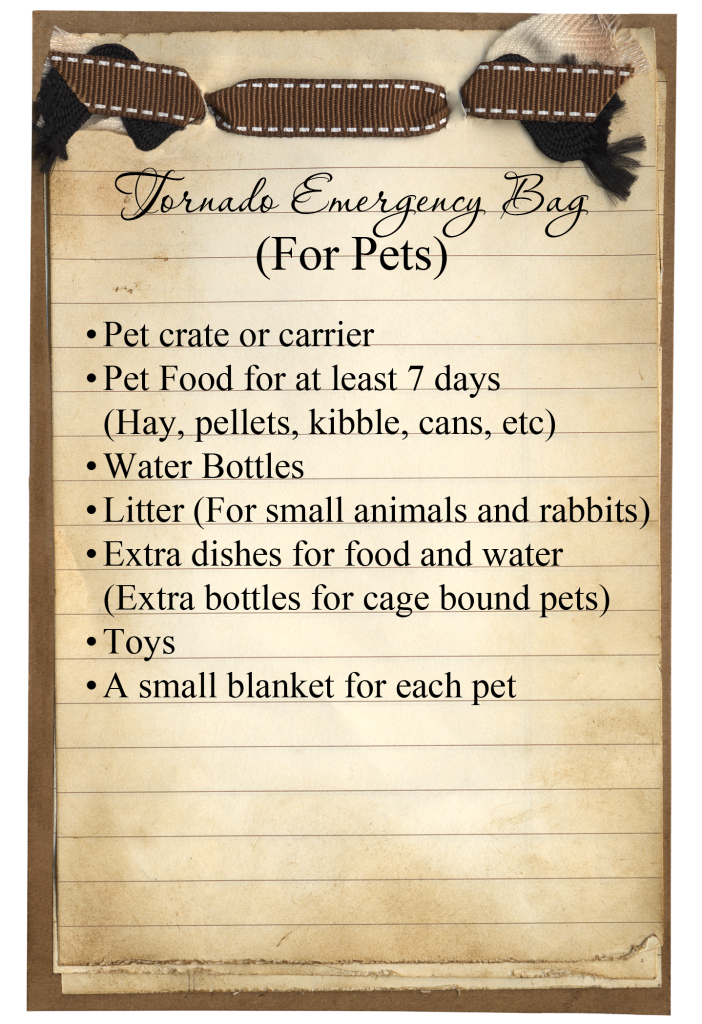
Pets have to have many of the same things we do in an emergency situation, but they also have to have access to things some people might not ever think about! Here's a good list for any pet owner to use.


If a tornado comes through and destroys everything, pet supplies will be some of the last things brought by aid agencies. First and foremost, you need a crate or carrier to keep the animal contained. Each of my bunnies has a pet carrier for transport, big enough that they fit, but small enough that they won't hurt themselves if they become stressed. If you have to carry your pet, I suggest putting a covered crate in your basement or shelter, so that the pet also has a safe place to be during the storm.

If you live out in the country, like I do, there are no pet shops around to just drive to...so you have to be sure to have enough food and water to last each pet a week. Thankfully, my bunnies don't eat too many pellets, but I have to pack hay and litter, something others might not have to worry about. Each pet should also have a clean container for food and water. I suggest putting all your supplies in a bag like the one below, which comes with collapsible food and water bowls, and a canteen for water.


 Blankets and toys are also a must! Animals can become very easily stressed and scared, which can sometimes lead them to be aggressive. The toys and blankets help calm the animals, as well as keep them dry and warm.

I hope this guide has helped you start to prepare for a possible tornado, and remind you that disaster can happen at any time...so you've got to be ready!

Love and Lightning Bugs,
  Photobucket

Thursday, November 29, 2012

My Soul's Kin

For those who may be curious, I have always had a great love of foxes. I have adored them since I too small to walk, and often times felt that they were a part of me...though I never knew how. Fast forward to the day I set out to find my spirit guide.

I was sitting beneath my patron tree, a Weeping Willow, in some nearby woods. After meditating for a few hours in the sunshine, and mentally calling for her...she came. I felt her presence before I opened my eyes to see her, but I knew she was meant for me. There, sitting on a rock directly in front of me, no more than 50 feet away, was a female fox. Her eyes were intense, but calm, and they seemed to look through me....or into me. I physically felt a jolt run through me, and before she gracefully departed, I bowed my head to her. She looked over her shoulder at me, and I swear I saw a nod returned, before she slipped off into the shadows of the trees.

"Red Fox" by Jay Mudaliar

That day, I found my spirit guide, and she found me. I was lucky enough to have a fox as my guardian animal, to help see me through life, teach me and aid me, and protect me in times of need. I felt complete for the first time in a long time...like some void in my heart had been filled. It may sound rather silly, and even weird to those who don't know the experience themselves. I've been told it's akin to finding your religious path, such as embracing Christianity and being baptized, or becoming a new mother and embracing your child for the first time.... something that fills a void you might not even know you had.

But perhaps a bit of history and understanding are needed to better understand why this animal means so much to me. Foxes are seen as power animals, spirit guides, and totems throughout the world. The Chinese believed foxes could take human form. In Egypt the fox brought favor from the gods. Foxes aid the dead get to the next life in Persia. The Cherokees, Hopi and various other Native American Indian tribes believed in its healing power, and the Apache credited the fox with giving man fire.

The fox is amongst the most uniquely skilled and ingenious animals of nature. Being a night creature, the fox is often imbued with supernatural powers. Foxes are usually seen at dawn and dusk. Dusk starts off their day, and the dawn is its ending. This is the time, in many Pagan ideologies when the world of magic and our every day realities cross paths. Foxes live on the edges of forests and open lands, the border areas. Since the fox is an animal of the between times and places, it can be a guide into the faerie realm. The fox has a long past of magic and cunning associated with it. It can move in and out of circumstance restoring order or causing confusion, depending on the occasion.

There are various species of fox, but they all share the extreme cleverness and cunning that paved the way for the expression, "sly as a fox." The fox urges me to develop the art of camouflage, invisibility, and 'shape-shifting'. To be able to conform to any situation that I may be put into, and to survive it. They are agile, skilled, and unpredictable.

The fox's power lies in not being able to outrun the hounds, but to know in advance when they will be out hunting. They then use their ability to camouflage. I have learned to detach from my surroundings, and to use all my senses to be observant. If I do that, I will also be able to anticipate and create the future. A fox being followed by hounds will run across the tops of walls, cross streams diagonally, double back on its trail, run in circles - in short, do anything to break the trail of its scent. The fox has the amazing ability to outwit both predators and prey. She shows me how to slip out of unpleasant situations quietly and unnoticed...something I have become quite adept at! Just ask anyone who has lost me at a party, lol.

Those with fox as a spirit guide are frequently smart and witty, but must remember to keep their crafty and clever demeanor balanced or it could backfire. The fox can also show you that your actions may be too obvious, and the need to learn to be more discreet. She is a wise, potent, teacher for those who choose to live conscious and deliberate lives.

Due to their ability to blend into their surroundings, foxes are generally viewed as sly and cunning beings. Interestingly, the word cunning, originates in the Old English word, kenning, which means to know, especially as applied to seeing something which isn't visible straight away. This can be related to the fox's superb sight and their ability to anticipate. 

"Fox Totem" by Susan Williams

She can show us the skills necessary when it comes to handling people, something we all need to work on at one time or another. Being pretty anti-social in large groups, and having anxiety issues, she teaches me how to best handle myself so that I won't have a panic attack.

She teaches me the ability to camouflage, which can be deduced as being able to take a step back and view an interpersonal situation with detachment. This includes opening up the less obvious senses, such as intuition. Often the underlying basis of a situation may seem obvious, but instead of making a quick judgment, I've learned to listen closely to the outer and inner senses. Then you may perhaps get a completely different picture of what is going on. When the outer situation and the inner senses don't match it is wise to handle like a fox, to trust ones intuition/instinct/inner voice, and to lay low.

Just like the wolf, the fox partner's for life, and is very devoted to its young. Many of its clever hunting techniques are keyed to acquire food for the helpless young and the nursing vixen. This is am important element of the foxes power. Similarly, our own awareness, and flexibility can be used to greater ends, not just to serve ourselves.

The fox's wisdom includes: Shape shifting, cleverness, observational skills, cunning, stealth, camouflage, feminine, courage, invisibility, ability to observe unseen, persistence, gentleness, swiftness, wisdom, reliable friend, magic, shape shifting, invisibility. 

With a fox as my spirit guide, learning to be invisible is very important in my life. I have always avoided large crowds, feeling too open and unprotected within them. As such, my anxiety attacks often come when I am asked to speak before a group, or make myself the center of attention for something. I have learned to picture myself blending in with my surroundings, becoming part of everything. Be extremely still and quiet. With practice and patience, I am now able to go unnoticed even, at a party or in a crowd.

If fox is your power animal, pay attention to the way it moves and follow its lead. This is a powerful guide to have and those that have it to should learn to use its skills for the benefit of all, including themselves.

I hope you've enjoyed this little peek into my soul.


Love and Lightning Bugs,
  Photobucket

Thursday, September 6, 2012

Conversations with Wild Bunnies

I had quite the visitor today! I went out to water my plants, and look who stopped by!

 "Hello human who has tamed my kin...I have come to watch you and learn the secret as to how you keep my kin inside, and controlled with an odd pink contraption when they come outside." At least, that's how I image he was talking, tee hee!


 "You brought me a carrot...I will tolerate your presence in my kingdom. But I still don't trust you. I will watch you from my favorite perch."


"What is this you have brought me? Apples? Well, perhaps you can come a bit closer. I am magnificent to look at, if I do say so myself."


 "I like you human...you offer me the gifts I deserve as king of the kingdom of 'Front Yard'. I will permit you to lie with me in the clover bed, and take my photos up close. Perhaps I will come back, and you may offer me more gifts of delicious food."


Just a fun conversation I mentally had with this adorable little bun! He was quite regal!

Love and Lightning Bugs,
  Photobucket